<?xml version="1.0" encoding="UTF-8"?>
<?xml-stylesheet type="text/xsl" href="/stylesheets/feed.atom.xml" media="screen"?>
<feed xml:lang="en-US" xmlns="http://www.w3.org/2005/Atom">
  <id>tag:sensorinitiative.nd.edu,2005:/news-events/news</id>
  <link rel="alternate" type="text/html" href="https://sensorinitiative.nd.edu"/>
  <link rel="self" type="application/atom+xml" href="https://sensorinitiative.nd.edu/news-events/news.atom"/>
  <id>tag:sensorinitiative.nd.edu,2005:/latest</id>
  <title>Sensor Initiative | News</title>
  <updated>2026-06-04T11:47:00-04:00</updated>
  <link rel="alternate" type="text/html" href="https://sensorinitiative.nd.edu/"/>
  <link rel="self" type="application/atom+xml" href="https://sensorinitiative.nd.edu//news-events/news.atom"/>
  <subtitle>The Notre Dame Sensor Initiative is a translational research center dedicated to developing innovative, accessible, and user-friendly sensor technologies that address some of the most pressing public health challenges of our time</subtitle>
  <entry>
    <id>tag:sensorinitiative.nd.edu,2005:News/182303</id>
    <published>2026-06-04T11:47:00-04:00</published>
    <updated>2026-06-04T11:47:25-04:00</updated>
    <link rel="alternate" type="text/html" href="https://sensorinitiative.nd.edu/news-events/news/college-of-science-announces-2025-26-faculty-awards/"/>
    <title>College of Science Announces 2025-26 Faculty Awards</title>
    <summary type="text">
      <![CDATA[Steve Corcelli, Ph.D., William K. Warren Foundation Dean of the College of Science, has announced the college’s faculty award recipients for the 2025–26 academic year. Father James L. Shilts, C.S.C./Doris and Gene Leonard Teaching Award Bestowed annually on a faculty member…]]>
    </summary>
    <content type="html">
      <![CDATA[<p>Steve Corcelli, Ph.D., William K. Warren Foundation Dean of the College of Science, has announced the college’s faculty award recipients for the 2025–26 academic year.</p>
<h2 dir="ltr">Father James L. Shilts, C.S.C./Doris and Gene Leonard Teaching Award</h2>
<p>Bestowed annually on a faculty member in the College of Science, this award is named in honor of Father James L. Shilts, C.S.C., who taught in the Department of Physics from 1961 until his death in 1982. The award was endowed in 1984 by Dr. Eugene T. Leonard III in memory of his parents, Dr. Eugene and Doris Leonard. Leonard III served on the Science Advisory Council from 1976 to 1991. The award recognizes a faculty member who has demonstrated sustained excellence in teaching.</p>
<figure class="image image-left"><img src="https://science.nd.edu/assets/605096/nds_maryalieberman_1200x675.jpg" alt="Marya Lieberman pictured in her office. Lieberman wears her dyed blue hair at shoulder length. She wears glasses, a black shirt, and a red sweater." width="600" height="338"></figure>
<p><strong>The 2026 recipient is <a href="https://chemistry.nd.edu/people/marya-lieberman/">Marya Lieberman</a>, Nancy Dee Professor of Cancer Research.</strong></p>
<p>Lieberman joined the Department of Chemistry and Biochemistry faculty in 1996 and was named the Nancy Dee Professor of Cancer Research in 2025. She has taught a broad range of courses across the chemistry and biochemistry curriculum, from introductory undergraduate classes to advanced undergraduate and graduate courses. She has also mentored numerous undergraduate and graduate student researchers.</p>
<p>The overarching theme of Lieberman’s career has been using chemistry to improve people’s lives. This commitment is reflected in both the courses she teaches and the mentoring relationships she builds with students. Through community-engaged courses and undergraduate research projects aimed at improving health and well-being for vulnerable communities, Lieberman embodies Notre Dame’s aspiration to educate the whole person—mind and spirit.</p>
<p>Lieberman is widely recognized for her contributions to education. In 2025, she received the American Chemical Society (ACS) Gustavus John Esselen Award for Chemistry in the Public Interest for her work developing paper analytical devices and training students and scientists to use them. She also received the 2022 J. Calvin Giddings Award for Excellence in Education and the 2010 Joyce Award for Excellence in Undergraduate Teaching. The 2026 James L. Shilts, C.S.C./Doris and Eugene Leonard Teaching Award further recognizes her sustained record of impactful teaching and student mentorship.</p>
<h2 dir="ltr">College of Science Research Award</h2>
<p>Each year, the College of Science recognizes an outstanding investigator who has made substantial recent contributions to their field. This award honors a highly productive faculty member whose research trajectory demonstrates growing national and international impact.</p>
<figure class="image image-left"><img src="https://science.nd.edu/assets/543744/7.13.21_xin_lu_2908.jpg" alt="Xin Lu" width="600" height="480"></figure>
<p><strong>The 2026 recipient is <a href="https://biology.nd.edu/people/xin-lu/">Xin Lu</a>, John M. and Mary Jo Boler Collegiate Professor.</strong></p>
<p>Lu joined the University of Notre Dame in 2017. He earned his Ph.D. in molecular biology from Princeton University in 2010. Prior to his appointment at Notre Dame, he held postdoctoral positions at the Dana-Farber Cancer Institute in Boston and the University of Texas M.D. Anderson Cancer Center in Houston. He was promoted to associate professor in 2022 and rapidly promoted to professor in 2026.</p>
<p>Lu is a leader in cancer immunotherapy and tumor immunology, with research focused on cancer-cell and microenvironment-driven mechanisms of immune evasion. His recent work has advanced both fundamental cancer immunology and new therapeutic strategies. Since earning tenure in 2022, Lu has published 44 papers, including original research, reviews, and editorials.</p>
<p>Further evidence of Lu’s research excellence can be seen in his robust funding record, which includes continuous support from the NIH and the Department of Defense, as well as several foundations, including Susan G. Komen and the Breast Cancer Alliance. His work has also been recognized through numerous honors, including the Rising Star Award from the Serican Academy of Urology in 2026 and the Coaches vs. Cancer Innovation Award from the American Cancer Society in 2025. At Notre Dame, he received the Department of Biological Sciences Faculty Excellence in Research Award.</p>
<p>Lu has also made significant service contributions to the scientific community. He serves as a standing member of the NIH Tumor Host Interactions Study Section and contributes to peer review as a guest editor and reviewer for numerous journals. As a Dean’s Fellow, he contributed to a review of graduate programs and student support across the College of Science. Through his research leadership, scholarly productivity, and service to the scientific community, Lu is highly deserving of the College of Science Research Award.</p>
<h2 dir="ltr">College of Science Outstanding Research Service Award</h2>
<p>The College of Science Outstanding Research Service Award recognizes a scientist who has made a significant difference in supporting scientific research across the college. The award highlights a research faculty or staff member whose technical expertise, consulting, training, or guidance has meaningfully advanced the work of others.</p>
<figure class="image image-left"><img src="https://science.nd.edu/assets/660272/evgenii_kovriginjpg.jpg" alt="Evgenii Kovrigin" width="600" height="750"></figure>
<p><strong>The 2026 recipient is <a href="https://chemistry.nd.edu/people/evgueni-kovriguine/">Evgenii Kovrigin</a>, research professor, and director of the Magnetic Resonance Research Center.</strong></p>
<p>Kovrigin joined the University of Notre Dame in 2018. He earned his Ph.D. in chemistry from the Engelhardt Institute of Molecular Biology in Moscow, Russia, in 1999. He held postdoctoral positions at the Institute of Protein Research in Pushchino, Russia; UT Southwestern Medical Center in Dallas; and Yale University. Prior to joining Notre Dame as a research associate professor, he served on the faculties of the Medical College of Wisconsin and Marquette University in Milwaukee. He was promoted to research professor in 2025 and serves as director of the Magnetic Resonance Research Center.</p>
<p>As director, Kovrigin supports eight instruments used by more than 200 researchers across the Colleges of Science and Engineering. He has also developed numerous software packages for analyzing NMR data that are used by researchers around the world.</p>
<p>In 2024, Kovrigin led the effort to build a custom helium storage system, the High Pressure Helium Reserve. Together with the Notre Dame Helium Recovery and Liquefaction Facility, the system helps prevent disruptions to NMR instrumentation caused by helium shortages. Beyond this work, Kovrigin hosted and co-organized the 8th Gateway NMR Conference at Notre Dame in 2023, bringing NMR spectroscopists from across the Midwest to campus. Through his technical leadership, infrastructure development, and support for researchers across disciplines, Kovrigin has made exceptional contributions to scientific research at Notre Dame.</p>
<h2 dir="ltr">Sister Kathleen Cannon Award for Excellence in Undergraduate Advising</h2>
<p>This award is named in honor of Sister Kathleen Cannon, O.P., D.Min., a longtime advisor for the science collegiate sequence majors and a tireless advocate for students from all backgrounds. Sister Kathleen served as associate dean of the College of Science from 1998 to 2022 and associate provost of the university from 1990 to 1997.</p>
<figure class="image image-left"><img src="https://science.nd.edu/assets/660276/davidveselik.jpg" alt="David J. Veselik" width="600" height="400"></figure>
<p><strong>The 2026 recipient is <a href="https://science.nd.edu/about/office-of-the-dean/david-veselik/">David Veselik</a>, associate dean of undergraduate advising.</strong></p>
<p>Veselik has been a tireless advocate for Notre Dame students. He advised students during the final years of the Science Business major, a program closely connected to Sister Kathleen’s work. Students who nominated Veselik praised his kindness and thoughtful, patient, and encouraging approach to advising. One student nomination captured the sentiment shared by many: “Dr. V deserves this award because he goes beyond course scheduling or degree requirements and empowers students to make decisions that reflect their actual goals.”</p>
<p>After serving for two years as a visiting assistant professor, Veselik joined the faculty as an assistant teaching professor in 2009 and was promoted to associate teaching professor in 2016. He began his advising career in 2013 when he became advisor and director of undergraduate studies for the Department of Biological Sciences. In recognition of his excellence in that role, he received the 2017 Dockweiler Award for Undergraduate Advising.</p>
<p>As associate dean for undergraduate advising in the College of Science, Veselik is known for his student-centered focus, calm and positive demeanor, sound judgment, and strong leadership. He also continues to teach in the Department of Biological Sciences and, in 2023, received a Rev. Edmund P. Joyce, C.S.C., Award for Excellence in Undergraduate Teaching.</p>
<h2 dir="ltr">Public Engagement in Science Award</h2>
<p>This award recognizes a faculty member in the College of Science who has demonstrated a sustained record of excellence in public engagement by making noteworthy contributions that increase the public’s understanding of science and scientific progress. Such excellence may include innovative outreach or educational initiatives, meaningful partnerships with community groups, programs that broaden access to science, new mechanisms to engage the community with our researchers, or impactful efforts that reach audiences traditionally underserved or overlooked in STEM.</p>
<figure class="image image-left"><img src="https://science.nd.edu/assets/660270/susan_del_vallejpg.jpg" alt="Susan del Valle" width="600" height="750"></figure>
<p><strong>The 2026 recipient is <a href="https://chemistry.nd.edu/people/susan-del-valle/">Susan del Valle</a>, associate teaching professor in the Department of Chemistry and Biochemistry.</strong></p>
<p>Del Valle, who also serves as faculty advisor for both the Chemistry &amp; Biochemistry Club and the Fighting Irish Science Olympiad, earned her B.A. in veterinary pharmacology from the University of Florida in 1996 and her Ph.D. in chemistry from the University of California in 2004. She completed a postdoctoral fellowship at the Université de Montréal before becoming an editorial assistant for the journal Organic Letters in 2006. After serving as an assistant professor of instruction at the University of Tampa, she joined the Notre Dame faculty in 2019.</p>
<p>At Notre Dame, del Valle’s mentorship and vision have enabled students to use their scientific knowledge and resources to make meaningful impacts across Northern Indiana and the Great Lakes region. Through the Chemistry &amp; Biochemistry Club, she has organized monthly opportunities for students to volunteer, socialize, and develop career resources.</p>
<p>Each January, del Valle leads Notre Dame’s annual Fighting Irish Science Olympiad, which typically brings more than 200 students from 10–20 regional schools to campus to showcase their scientific knowledge. Her leadership and organization have made the event a sustained success, earning consistent praise from participants and the broader community.</p>
<p><strong id="docs-internal-guid-25e44544-7fff-1c0a-6a43-af009be2d255"> </strong></p>
<p class="attribution">Originally published by <span class="rel-author">Samantha Keller</span> at <span class="rel-source"><a href="https://science.nd.edu/news-and-media/news/college-of-science-announces-2025-26-faculty-awards/">science.nd.edu</a></span> on <span class="rel-pubdate">May 19, 2026</span>.</p>]]>
    </content>
    <link rel="enclosure" type="image/jpeg" href="https://sensorinitiative.nd.edu/assets/661720/mlc_42326_campus_aerials_13jpg.jpg" title="Aerial view of the Notre Dame Main Circle, Golden Dome, and Basilica"/>
    <author>
      <name>Samantha Keller</name>
    </author>
  </entry>
  <entry>
    <id>tag:sensorinitiative.nd.edu,2005:News/182235</id>
    <published>2026-06-03T10:00:00-04:00</published>
    <updated>2026-06-02T13:57:03-04:00</updated>
    <link rel="alternate" type="text/html" href="https://sensorinitiative.nd.edu/news-events/news/nd-sensor-initiative-installment-new-instruments-specialized-mass-spectrometers/"/>
    <title>ND Sensor Initiative announces installment of new, specialized mass spectrometers</title>
    <summary type="text">
      <![CDATA[The Shimadzu LCMS-8050 Triple Quadrupole…]]>
    </summary>
    <content type="html">
      <![CDATA[<figure class="image image-right"><img src="https://sensorinitiative.nd.edu/assets/661377/asend_032326_equipment_imagery_update_19.jpg" alt="Black Shimadzu LC modules with bottles, white and black LCMS-8050RX mass spectrometer, copper piping in a lab." width="600" height="400">
<figcaption>The Shimadzu LCMS-8050 Triple Quadrupole Mass Spectrometer. Photo by Angelic Rose Hubert/Notre Dame Research.</figcaption>
</figure>
<p>Earlier this spring, the <a href="https://sensorinitiative.nd.edu/">Notre Dame Sensor Initiative</a> (NDSI) installed two new instruments in the <a href="https://asend.nd.edu/">Analytical Science and Engineering</a> (ASEND) core facility, made possible with funding from the <a href="https://strategicframework.nd.edu/initiatives/health-and-well-being/bioengineering-and-life-sciences-bels/">Bioengineering and Life Sciences</a> (BELS) Initiative and support from <a href="https://research.nd.edu/">Notre Dame Research</a>.</p>
<p>A new permanent acquisition, a <a href="https://asend.nd.edu/instrumentation/shimadzu-lcms-8050rx/">Shimadzu LCMS-8050 Triple Quadrupole Mass Spectrometer</a>, is engineered for fast, high-sensitivity quantitation. The instrument features high speed polarity switching times and rapid rates of data acquisition, serving as an important tool for rapid multi-component analysis and simultaneous qualitative and quantitative testing.</p>
<p>Notre Dame Serving Community Analytical Needs (ND-SCAN), a project of the NDSI, will employ the Shimadzu LCMS-8050 in service of research on the opioid crisis and dual-use sensing technology.</p>
<p>In addition, Shimadzu Scientific Instruments has loaned a <a href="https://asend.nd.edu/instrumentation/shimadzu-lcms-9050-q-tof-mass-spectrometer/">LCMS-9050 Q-TOF Mass Spectrometer</a> to ND-SCAN for one year. The Quadrupole Time-of-Flight (Q-TOF) mass spectrometer features stable polarity switching and high-precision temperature control, allowing for simultaneous positive and negative ion analysis. The instrument will support advanced testing capabilities and the development of a shared data library.</p>
<figure class="image image-right"><img src="https://sensorinitiative.nd.edu/assets/661375/asend_032326_equipment_imagery_update_12.jpg" alt="Black, white, and copper Shimadzu LCMS-9030 mass spectrometer with green status lights illuminated." width="600" height="400">
<figcaption>The Shimadzu LCMS-9050 Q-TOF Mass Spectrometer, on loan to ND-SCAN. Photo by Angelic Rose Hubert/Notre Dame Research.</figcaption>
</figure>
<p>“Integrating these top-of-the-line, highly-sensitive mass spectrometers into the ASEND facility dramatically elevates Notre Dame's analytical capabilities, allowing us to map complex chemical data faster than ever before,” said <a href="https://engineering.nd.edu/faculty/nosang-myung/">Nosang Myung</a>, the Bernard Keating-Crawford Professor of <a href="https://engineering.nd.edu/">Engineering</a>, who also serves as faculty director of the NDSI and the ASEND core facility. “This cutting-edge technology will empower our faculty and students to drive high-impact research, directly fueling ND-SCAN's critical mission to address urgent societal challenges like the opioid crisis."</p>
<p>The instruments are available for use through the <a href="https://asend.nd.edu/">ASEND core facility</a>. Please visit the <a href="https://asend.nd.edu/">ASEND website</a> to learn more, request training, and schedule equipment.</p>
<p>NDSI and ND-SCAN are supported in part by the <a href="https://strategicframework.nd.edu/initiatives/health-and-well-being/bioengineering-and-life-sciences-bels/">Notre Dame Bioengineering &amp; Life Sciences Initiative</a>, an effort that aims to advance human health and wellness through interdisciplinary biomedical research and training. To learn more, please visit the <a href="http://sensorinitiative.nd.edu/">NDSI website</a> and the <a href="https://strategicframework.nd.edu/news/multi-unit-research-teams-receive-support-for-bioengineering-and-life-sciences-projects/">University’s Strategic Framework website</a>.</p>
<p><strong>Contact</strong></p>
<p>Erin Fennessy / Writing Program Manager</p>
<p>Notre Dame Research / University of Notre Dame</p>
<p>efenness@nd.edu / +1 574-631-8183</p>
<p>research.nd.edu / @UNDResearch / <a href="http://linkedin.com/company/undresearch">linkedin.com/company/undresearch</a></p>
<p><strong>About Notre Dame Research</strong></p>
<p>The University of Notre Dame is a private research and teaching university inspired by its Catholic mission. Located in South Bend, Indiana, its researchers are advancing human understanding through research, scholarship, education, and creative endeavor in order to be a repository for knowledge and a powerful means for doing good in the world. For more information, please visit <a href="http://research.nd.edu">NDR's website</a> or <a href="https://www.linkedin.com/company/undresearch/">NDR's LinkedIn</a>.</p>]]>
    </content>
    <link rel="enclosure" type="image/jpeg" href="https://sensorinitiative.nd.edu/assets/661376/asend_032326_equipment_imagery_update_28.jpg" title="Two black and white Shimadzu LCMS-8060 and LCMS-9050 instruments in a Notre Dame research lab."/>
    <author>
      <name>Erin Fennessy Lawlor</name>
    </author>
  </entry>
  <entry>
    <id>tag:sensorinitiative.nd.edu,2005:News/180256</id>
    <published>2026-03-25T10:00:00-04:00</published>
    <updated>2026-03-24T15:00:50-04:00</updated>
    <link rel="alternate" type="text/html" href="https://sensorinitiative.nd.edu/news-events/news/notre-dame-researchers-to-advance-detection-and-community-knowledge-of-opioids-including-new-variants/"/>
    <title>Notre Dame researchers to advance detection and community knowledge of opioids, including new variants</title>
    <summary type="text">
      <![CDATA[Four teams of researchers across the College of Science and the College of Engineering have been selected to receive seed funding from the Notre Dame Sensor Initiative (NDSI) for research advancing affordable, fast, and accurate platforms for on-site…]]>
    </summary>
    <content type="html">
      <![CDATA[<p>Four teams of researchers across the College of Science and the College of Engineering have been selected to receive seed funding from the <a href="https://sensorinitiative.nd.edu/">Notre Dame Sensor Initiative (NDSI)</a> for research advancing affordable, fast, and accurate platforms for on-site opioid detection.</p>
<p>As opioid overdoses continue to cause high rates of death and hospitalization nationwide, these researchers will work to develop devices that enable the rapid detection of opioids and other biological and chemical threats. Current laboratory methods allow for highly sensitive and accurate drug identification, but require the use of complex equipment and cost valuable time. On-site testing methods are also limited in their ability to detect low concentrations of substances as well as evolving opioid derivatives.</p>
<p>Notre Dame researchers will work to bring the accuracy of current lab methods to the field with portable devices designed to detect opioid presence, as well as partner with community organizations to increase awareness of the opioid crisis and new testing advancements.</p>
<p>“Detection is the first big hurdle to addressing the opioid crisis,” said <a href="https://sensorinitiative.nd.edu/people/nosang-myung/">Nosang Myung</a>, director of the NDSI and the Bernard Keating-Crawford Professor of <a href="http://engineering.nd.edu">Engineering</a>. “Providing individuals and organizations the resources to do so on-site and through our state-of-the-art facilities gives them the ability to collect valuable data that can then be used to improve public health outcomes.”</p>
<p>The projects selected are described below.</p>
<h2>Turning fluorescence technology into a broad-scale detection system</h2>
<p>Aiming to produce a portable sensor capable of detecting a wider range of opioid derivatives than current on-site techniques, <a href="https://engineering.nd.edu/faculty/yichun-wang/">Yichun Wang</a>, the Keating-Crawford Collegiate Professor of Biomolecular Engineering in the <a href="https://cbe.nd.edu/">Department of Chemical and Biomolecular Engineering</a>, will lead a project focusing on supramolecular-quantum dot (S-Qdot) fluorescence methods in conjunction with <a href="https://engineering.nd.edu/faculty/matthew-webber/">Matthew Webber</a>, the Keating-Crawford Collegiate Professor of Engineering and acting director of the <a href="https://precisionhealth.nd.edu/">Berthiaume Institute for Precision Health</a>, and <a href="https://www.linkedin.com/in/thomas-o-sullivan-5557567/">Thomas O'Sullivan</a>, the Frank M. Freimann Collegiate Professor of Biomedical Electronics in the <a href="https://ee.nd.edu/">Department of Electrical Engineering</a>.</p>
<p>The project will build off previous work from Wang and Webber, which developed an S-Qdot fluorescent sensor, and previous work from O'Sullivan, who collaborated with Wang’s team to produce a working prototype portable device. The prototype detected a model drug at low concentrations—comparable to the current “gold standard” of in-lab measurement, liquid chromatography-mass spectrometry (LC-MS)—and more than 50 fentanyl analogs. The team’s seed-funded project will progress the prototype by enabling wireless data transfer and conducting field tests, thereby further refining the device’s stability and precision.</p>
<h2>Applying membranes to collect and detect opioids in biological samples</h2>
<p>Detection of opioids in biological samples such as urine and blood plasma generally requires precision at very low concentrations, normally requiring a lengthy process of sample treatment and analysis via LC-MS.</p>
<p><a href="https://chemistry.nd.edu/people/merlin-bruening/">Merlin Bruening</a>, the Donald and Susan Rice Professor of <a href="https://engineering.nd.edu/">Engineering</a>, and <a href="https://chemistry.nd.edu/people/kaiyu-fu/">Kaiyu Fu</a>, associate professor in the <a href="https://chemistry.nd.edu/">Department of Chemistry and Biochemistry</a>, will work to simplify this process using a membrane-based device that can adsorb drugs from a solution, removing contaminants and increasing the drug’s concentration for better detection. These membranes could also allow for stable storage and transport of samples from areas where testing may not be immediately available. The team will also integrate nano-electrodes equipped with opioid-binding molecules into the membrane devices, yielding a portable device capable of detecting drugs in low amounts and transforming the technology into a sensor platform capable of highly selective detection in the field.</p>
<h2>Developing portable bioassays to detect new opioids</h2>
<p>When opioids with novel chemical structures enter the street drug supply, it can take months to years to figure out what they are and how potent they are. Meanwhile, they can cause clusters of overdoses that are difficult to predict or treat. Notre Dame researchers want to predict opioid effects and potency of novel substances on the human body, without waiting for overdoses to occur in humans.</p>
<p><a href="https://chemistry.nd.edu/people/holly-goodson/">Holly Goodson</a>, professor, and <a href="https://chemistry.nd.edu/people/marya-lieberman/">Marya Lieberman</a>, Nancy Dee Professor of Cancer Research, in the <a href="https://chemistry.nd.edu/">Department of Chemistry and Biochemistry</a>, supported by Patrick Flynn, Fritz Duda Family Professor of Engineering in the <a href="https://cse.nd.edu/">Department of Computer Science and Engineering</a>, will focus on developing portable bioassays—measurement devices that involve living systems—to assess the potency of unknown street drugs using a smartphone. The key is a strain of C. elegans modified by researchers at the University of Washington, Seattle, to express the human opioid receptor and behave differently when exposed to opioids. The final prototype will clip onto a phone camera to record their reaction to a drug sample. The system then uses a computer program to track the reaction and correlate it with the concentration of opioids present, since different amounts of opioids cause variations in behavior.</p>
<h2>Forging data-sharing community partnerships</h2>
<p>In order to respond to the presence of drugs in a community, the sharing of information among stakeholders is essential. Lieberman, associate director of the NDSI, will establish a community advisory board to set up agreements for sample collection and data sharing with external partners, including harm reduction groups, departments of public health, and first responders.</p>
<p>In addition, <a href="https://sensorinitiative.nd.edu/about/research/nd-scan-notre-dame-serving-community-analytical-needs/">Notre Dame Serving Community Analytical Needs</a> (ND-SCAN), the outreach arm of the NDSI, will offer free, high-level analysis of “drug trash” samples at the <a href="https://asend.nd.edu/">Analytical Science and Engineering at Notre Dame</a> (ASEND) core facility, facilitating data collection on the presence of drugs in communities on behalf of these partners. In making this service available to external partners, ND-SCAN will support improving community response to changes in the composition of street drugs. The project will also develop, validate, and publish literature on methods for the analysis of drug trash.</p>
<p>NDSI and ND-SCAN are supported in part by the <a href="https://strategicframework.nd.edu/initiatives/health-and-well-being/bioengineering-and-life-sciences-bels/">Notre Dame Bioengineering &amp; Life Sciences Initiative</a>, an effort that aims to advance human health and wellness through interdisciplinary biomedical research and training. To learn more, please visit the <a href="http://sensorinitiative.nd.edu">NDSI website</a> and the <a href="https://strategicframework.nd.edu/news/multi-unit-research-teams-receive-support-for-bioengineering-and-life-sciences-projects/">University’s Strategic Framework website</a>.</p>
<p><strong>Contact</strong></p>
<p>Erin Fennessy / Writing Program Manager</p>
<p>Notre Dame Research / University of Notre Dame</p>
<p>efenness@nd.edu / +1 574-631-8183</p>
<p>research.nd.edu / @UNDResearch / <a href="http://linkedin.com/company/undresearch">linkedin.com/company/undresearch</a></p>
<p><strong>About Notre Dame Research</strong></p>
<p>The University of Notre Dame is a private research and teaching university inspired by its Catholic mission. Located in South Bend, Indiana, its researchers are advancing human understanding through research, scholarship, education, and creative endeavor in order to be a repository for knowledge and a powerful means for doing good in the world. For more information, please visit <a href="http://research.nd.edu">NDR's website</a> or <a href="https://www.linkedin.com/company/undresearch/">NDR's LinkedIn</a>.</p>]]>
    </content>
    <link rel="enclosure" type="image/jpeg" href="https://sensorinitiative.nd.edu/assets/653632/biph_031325_biph_bioscope_18.jpg" title="Several glass vials containing bright blue fluorescent liquid on a dark surface under blue light."/>
    <author>
      <name>Monica Sayler</name>
    </author>
  </entry>
  <entry>
    <id>tag:sensorinitiative.nd.edu,2005:News/178922</id>
    <published>2026-02-03T13:40:00-05:00</published>
    <updated>2026-02-03T13:40:44-05:00</updated>
    <link rel="alternate" type="text/html" href="https://sensorinitiative.nd.edu/news-events/news/notre-dame-researchers-to-advance-biothreat-surveillance-containment-and-operational-preparedness/"/>
    <title>Notre Dame researchers to advance biothreat surveillance, containment, and operational preparedness</title>
    <summary type="text">
      <![CDATA[Three faculty teams have been selected as the first recipients of awards from the Notre Dame Biothreat Surveillance, Containment, &amp; Operational Preparedness Engine (ND-BIOSCOPE) Accelerator Fund, which fosters…]]>
    </summary>
    <content type="html">
      <![CDATA[<p>Three faculty teams have been selected as the first recipients of awards from the <a href="https://precisionhealth.nd.edu/opportunities/nd-bioscope-accelerator-fund/">Notre Dame Biothreat Surveillance, Containment, &amp; Operational Preparedness Engine </a>(ND-BIOSCOPE) Accelerator Fund, which fosters and further develops Notre Dame’s expertise in biothreat detection, surveillance, and countermeasure development.</p>
<p>A cross-disciplinary initiative of the <a href="https://precisionhealth.nd.edu/">Berthiaume Institute for Precision Health</a> (BIPH), <a href="https://sensorinitiative.nd.edu/">ND Sensor Initiative</a> (NDSI), the <a href="https://drugdiscovery.nd.edu/">Warren Center for Drug Discovery</a>, and <a href="https://redi-net.nd.edu/">Remote Emerging Disease Intelligence Network</a> (REDI-NET), ND-BIOSCOPE aims to build capacity in next-generation sensor technologies, artificial intelligence-driven analytics, biosurveillance networks, and rapid therapeutic countermeasure development pipelines to strengthen global health resilience. Projects supported by the initiative’s Accelerator Fund will enhance Notre Dame’s collaborative research capacity, strengthen translational pipelines, and position the University for sustained leadership and competitiveness in emergent biothreat preparedness.</p>
<p>"ND-BIOSCOPE provides a unifying framework for advancing Notre Dame’s leadership in biothreat surveillance, detection, and response,” said <a href="https://engineering.nd.edu/faculty/matthew-webber/">Matthew Webber</a>, ND-BIOSCOPE’s principal investigator and acting director of <a href="https://precisionhealth.nd.edu/about/">BIPH</a>. “The Accelerator Fund will not only advance innovative research, but also build durable institutional capacity through collaboration, training, and translation.”</p>
<p>The projects supported in this Accelerator Fund award cycle are described below:</p>
<h2>Developing transformative diagnostic systems</h2>
<p>Anticipating the next pandemic requires building next-generation platforms for disease monitoring and rapid development of targeted therapeutics. <a href="https://engineering.nd.edu/faculty/kyle-bibby/">Kyle Bibby</a>, associate chair in the <a href="https://ceees.nd.edu/">Department of Civil and Environmental Engineering and Earth Sciences</a>, will lead a project to design and scale large-library virus monitoring and infection screening platforms in conjunction with <a href="https://engineering.nd.edu/faculty/hsueh-chia-chang/">Hsueh-Chia Chang</a>, the Bayer Corporation Professor in the <a href="https://cbe.nd.edu/">Department of Chemical and Biomolecular Engineering</a>, and <a href="https://chemistry.nd.edu/people/brian-baker/">Brian Baker</a>, the Coleman Professor of Life Sciences in the <a href="https://chemistry.nd.edu/">Department of Chemistry and Biochemistry</a>.</p>
<p>The team will develop two integrated, high-throughput analytical platforms based on proprietary nanoparticle technology. The first of these two platforms is intended for environmental disease surveillance via wastewater, while the second will provide ultra-sensitive screening and detection of immune signatures of infection and difficult-to-detect latent viruses. <a href="https://engineering.nd.edu/faculty/meenal-datta/">Meenal Datta</a>, the Jane Schoelch DeFlorio Collegiate Professor in the <a href="https://ame.nd.edu/">Department of Aerospace and Mechanical Engineering</a>, and <a href="https://engineering.nd.edu/faculty/yamil-j-colon/">Yamil Colon</a>, associate professor in the <a href="https://cbe.nd.edu/">Department of Chemical and Biomolecular Engineering</a>, will contribute expertise in immune-cell cultures and artificial intelligence, respectively.</p>
<h2>Automating real-time outbreak forecasting</h2>
<p>Early identification of disease outbreaks is critical for saving lives. Current disease-monitoring platforms are largely retrospective and static, lacking automated analysis that converts incoming data into actionable insight. To bridge this gap, <a href="https://biology.nd.edu/people/jason-rohr/">Jason Rohr</a>, the Galla College Professor and chair of the <a href="https://biology.nd.edu/">Department of Biological Sciences</a>, will collaborate with <a href="https://niteshchawla.nd.edu/">Nitesh Chawla</a>, director of the <a href="https://lucyinstitute.nd.edu/">Lucy Family Institute for Data and Society</a> and the <a href="https://strategicframework.nd.edu/initiatives/data-ai-computing/">Data, AI &amp; Computing Initiative</a>, and <a href="https://research.nd.edu/people/samuel-rund/">Samuel Rund</a>, research assistant professor in the <a href="https://crc.nd.edu/">Center for Research Computing</a> (CRC) and affiliate of the <a href="https://globalhealth.nd.edu/">Eck Institute for Global Health</a>. <a href="https://lucyinstitute.nd.edu/people/the-lucy-family-core-team/postdoctoral-researchers/qinghua-zhao/">Qinghua Zhao</a>, a postdoctoral scholar and disease ecologist within the <a href="https://biology.nd.edu/">Department of Biological Sciences</a> and <a href="https://lucyinstitute.nd.edu/">Lucy Family Institute for Data and Society</a>, will support the project.</p>
<p>The team will develop a cloud-based biosurveillance platform aided by AI for real-time pandemic forecasting and health-system alerts. The platform will automatically take in multi-source surveillance and sensor data, generating real-time forecasts of disease trajectories—including outbreak start, peak timing, intensity, and duration. The platform will make outputs visible, while automatically issuing alerts via messaging services once outbreak benchmarks are reached.</p>
<h2>Optimizing dual-action antibiotics</h2>
<p>As the most common healthcare-associated infection, Clostridioides difficile infection (CDI) is an urgent public health threat, killing seven times more people than the next four most urgent threats combined. While normal, healthy gut conditions limit the flourishing of C. difficile, broad-spectrum antibiotic treatments disrupt normal gut health and permit the germination of the bacteria.</p>
<p><a href="https://chemistry.nd.edu/people/mayland-chang/">Mayland Chang</a>, research professor in the <a href="https://chemistry.nd.edu/">Department of Chemistry and Biochemistry</a>, together with <a href="https://chemistry.nd.edu/people/shahriar-mobashery/">Shahriar Mobashery</a>, Navari Family Professor in Life Sciences in the <a href="https://chemistry.nd.edu/">Department of Chemistry and Biochemistry</a>, will pursue the optimization of dual-action antibiotics to halt the recurrence of CDI. The researchers will synthesize dimers of oxadiazoles, a promising class of antibiotics, and evaluate their effectiveness in both preventing C. difficile germination and killing vegetative bacteria cells.</p>
<p>“Spanning advanced computing, diagnostic surveillance, and early-stage drug development, the inaugural Accelerator Award teams highlight the depth of talent on our campus, the breadth of our emerging expertise, and the momentum needed to scale this effort,” said Webber.</p>
<p>ND-BIOSCOPE is also supported by the <a href="https://strategicframework.nd.edu/initiatives/health-and-well-being/bioengineering-and-life-sciences-bels/">Notre Dame Bioengineering &amp; Life Sciences Initiative</a>, an effort that aims to advance human health and wellness through interdisciplinary biomedical research and training. To learn more about ND-BIOSCOPE, please visit the <a href="https://precisionhealth.nd.edu/opportunities/nd-bioscope-accelerator-fund/">BIPH website</a> and the <a href="https://strategicframework.nd.edu/news/multi-unit-research-teams-receive-support-for-bioengineering-and-life-sciences-projects/">University’s Strategic Framework website</a>.</p>
<p><strong>C</strong><strong>ontact</strong></p>
<p>Erin Fennessy / Writing Program Manager</p>
<p>Notre Dame Research / University of Notre Dame</p>
<p>efenness@nd.edu / +1 574-631-8183</p>
<p>research.nd.edu / @UNDResearch / <a href="http://linkedin.com/company/undresearch">linkedin.com/company/undresearch</a></p>
<p><strong>About Notre Dame Research</strong></p>
<p>The University of Notre Dame is a private research and teaching university inspired by its Catholic mission. Located in South Bend, Indiana, its researchers are advancing human understanding through research, scholarship, education, and creative endeavor in order to be a repository for knowledge and a powerful means for doing good in the world. For more information, please visit <a href="http://research.nd.edu">NDR's website</a> or <a href="https://www.linkedin.com/company/undresearch/">NDR's LinkedIn</a>.</p>
<p class="attribution">Originally published by <span class="rel-author">Erin Fennessy</span> at <span class="rel-source"><a href="https://research.nd.edu/news-and-events/news/notre-dame-researchers-to-advance-biothreat-surveillance-containment-and-operational-preparedness/">research.nd.edu</a></span> on <span class="rel-pubdate">February 03, 2026</span>.</p>]]>
    </content>
    <link rel="enclosure" type="image/jpeg" href="https://sensorinitiative.nd.edu/assets/647299/mc_22125_bels_06_2_jpg.jpg" title="A person in blue gloves carefully pipettes liquid into a clear round culture dish containing a square and circular well, on a dark lab bench."/>
    <author>
      <name>Erin Fennessy Lawlor</name>
    </author>
  </entry>
  <entry>
    <id>tag:sensorinitiative.nd.edu,2005:News/178048</id>
    <published>2025-12-18T08:30:00-05:00</published>
    <updated>2025-12-17T14:00:16-05:00</updated>
    <link rel="alternate" type="text/html" href="https://sensorinitiative.nd.edu/news-events/news/visit-from-hanyang-erica-delegation-advances-international-research-exchange/"/>
    <title>Visit from Hanyang-ERICA delegation advances international research exchange</title>
    <summary type="text">
      <![CDATA[Earlier this fall, a delegation from Hanyang University, South Korea, visited the University of Notre Dame to engage in conversation with university leadership and faculty. Hosted by Nosang Myung,…]]>
    </summary>
    <content type="html">
      <![CDATA[<p>Earlier this fall, a delegation from <a href="https://www.hanyang.ac.kr/web/eng">Hanyang University</a>, South Korea, visited the University of Notre Dame to engage in conversation with university leadership and faculty. Hosted by <a href="https://engineering.nd.edu/faculty/nosang-myung/">Nosang Myung</a>, the Bernard Keating-Crawford Professor of Engineering, the delegation represented Hanyang University’s <a href="https://www.hanyang.ac.kr/web/eng/erica-campus1">Education Research Industry Cluster at Ansan</a> (ERICA) campus.</p>
<p>Founded with the establishment of South Korea’s first engineering institute in 1939, Hanyang is a private research university with campuses in Seoul and Ansan. The ERICA campus is one of Korea’s top education, research, and industry clusters.</p>
<p>While at Notre Dame, the Hanyang-ERICA delegation met with <a href="https://global.nd.edu/about/people/michael-pippenger/">Michael Pippenger</a>, associate provost &amp; vice president for internationalization, and <a href="https://graduateschool.nd.edu/about/michael-hildreth/">Michael Hildreth</a>, associate provost &amp; vice president for graduate studies, in addition to receiving a tour of campus.</p>
<figure class="image image-right"><img src="https://sensorinitiative.nd.edu/assets/642911/500x/jeff.jpg" alt='A man in a grey blazer and glasses gestures, presenting "Advanced 3D Stacking Technology for High Performance Computing" on a screen with a blue geometric background to an audience.' width="500" height="333">
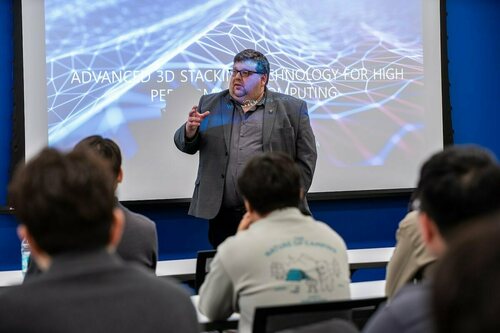
<figcaption>Jeffrey F. Rhoads, the John and Catherine Martin Family Vice President for Research, opens the workshop portion of the delegation’s visit to the University of Notre Dame. Photo by Angelic Rose Hubert.</figcaption>
</figure>
<p>Later, Notre Dame faculty experts in design, precision health, nanotechnology, sensor technology, and sustainability shared knowledge with Hanyang leaders and faculty during an afternoon workshop, which opened with remarks from <a href="https://research.nd.edu/people/jeffrey-rhoads/">Jeffrey F. Rhoads</a>, the John and Catherine Martin Family Vice President for Research and professor in the <a href="https://ame.nd.edu/">Department of Aerospace and Mechanical Engineering</a>.</p>
<p>“Moments of international exchange like the one we facilitated here at Notre Dame have the special potential to amplify the impact of our research in tandem with our peers at Hanyang,” said Myung, who is also the director of the <a href="https://sensorinitiative.nd.edu/">Notre Dame Sensor Initiative</a>. “We have so much to learn from each other, and I’m very pleased with the conversations that were initiated by this meeting.”</p>
<p>Among the presenters were Bongyoung Yoo, vice president for international affairs, Hanyang University-ERICA; <a href="https://engineering.nd.edu/faculty/matthew-webber/">Matthew Webber</a>, acting director of the <a href="https://precisionhealth.nd.edu/">Berthiaume Institute for Precision Health</a>; <a href="https://engineering.nd.edu/faculty/steven-koester/">Steve Koester</a>, director of <a href="https://nano.nd.edu/">NDnano</a>; <a href="https://engineering.nd.edu/faculty/joule-bergerson/">Joule Bergerson</a>, director of <a href="https://energy.nd.edu/">ND Energy</a>; and <a href="https://chemistry.nd.edu/people/marya-lieberman/">Marya Lieberman</a>, associate director of the <a href="https://sensorinitiative.nd.edu/">Notre Dame Sensor Initiative</a>.</p>
<figure class="image image-left"><img src="https://sensorinitiative.nd.edu/assets/629136/300x/nosang_myung.jpg" alt="Headshot of a person with glasses, wearing a white collared shirt and a navy blue v-neck sweater, smiling against a dark gray background." width="300" height="300">
<figcaption>Nosang Myung</figcaption>
</figure>
<p>“I’m grateful to my colleagues at Notre Dame and our friends at Hanyang for contributing their expertise to this exchange, as well as for their openness to global partnership,” Myung said.</p>
<p>To close the day of conversation and connection, the visiting delegation toured Notre Dame’s state-of-the-art engineering and materials analysis facilities. A tour of <a href="https://facilities.nd.edu/projects/current-major-projects/mccourtney-hall/">McCourtney Hall</a> featured visits to the labs of <a href="https://engineering.nd.edu/faculty/nosang-myung/">Myung</a>, and <a href="https://engineering.nd.edu/faculty/rev-bryan-d-paulsen-s-j/">Rev. Bryan Paulsen, S.J.</a>, assistant professor in the <a href="https://cbe.nd.edu/">Department of Chemical and Biomolecular Engineering</a>. The delegation also visited the <a href="https://asend.nd.edu/">Analytical Science and Engineering at Notre Dame</a> (ASEND) core facility in McCourtney Hall and the <a href="https://mcf.nd.edu/">Materials Characterization Facility</a> in Stepan Chemistry Hall, both of which are directed by Myung, as well as the <a href="https://nanofabrication.nd.edu/">Notre Dame Nanofabrication Facility</a> in the Stinson-Remick Hall of Engineering.</p>
<p>Learn more about the innovative sensor research taking place at Notre Dame on the <a href="https://sensorinitiative.nd.edu/">Sensor Initiative website</a>.</p>
<p><strong> </strong></p>
<p><strong>Contact</strong></p>
<p>Erin Fennessy / Writing Program Manager</p>
<p>Notre Dame Research / University of Notre Dame</p>
<p>efenness@nd.edu / +1 574-631-8183</p>
<p>research.nd.edu / @UNDResearch / <a href="http://linkedin.com/company/undresearch">linkedin.com/company/undresearch</a></p>
<p><strong> </strong></p>
<p><strong>About Notre Dame Research</strong></p>
<p>The University of Notre Dame is a private research and teaching university inspired by its Catholic mission. Located in South Bend, Indiana, its researchers are advancing human understanding through research, scholarship, education, and creative endeavor in order to be a repository for knowledge and a powerful means for doing good in the world. For more information, please visit <a href="http://research.nd.edu">NDR's website</a> or <a href="https://www.linkedin.com/company/undresearch/">NDR's LinkedIn</a>.<strong id="docs-internal-guid-6ab1af4c-7fff-ce7b-7306-521eebbc7f4b"></strong></p>]]>
    </content>
    <link rel="enclosure" type="image/jpeg" href="https://sensorinitiative.nd.edu/assets/642911/jeff.jpg" title="A man in a grey blazer and glasses gestures, presenting &quot;Advanced 3D Stacking Technology for High Performance Computing&quot; on a screen with a blue geometric background to an audience."/>
    <author>
      <name>Erin Fennessy Lawlor</name>
    </author>
  </entry>
  <entry>
    <id>tag:sensorinitiative.nd.edu,2005:News/176869</id>
    <published>2025-11-25T15:31:00-05:00</published>
    <updated>2025-11-25T15:31:25-05:00</updated>
    <link rel="alternate" type="text/html" href="https://sensorinitiative.nd.edu/news-events/news/notre-dame-community-organizations-partner-on-opioid-sensing-research/"/>
    <title>Notre Dame, Community Organizations Partner on Opioid Sensing Research</title>
    <summary type="text">
      <![CDATA[On Monday, November 3, community collaborators from the South Bend-Elkhart region gathered with University of Notre Dame researchers and staff on the Notre Dame campus for a community engagement workshop for Notre Dame Serving Community Analytical Needs (ND-SCAN), organized…]]>
    </summary>
    <content type="html">
      <![CDATA[<p>On Monday, November 3, community collaborators from the South Bend-Elkhart region gathered with University of Notre Dame researchers and staff on the Notre Dame campus for a community engagement workshop for <a href="https://sensorinitiative.nd.edu/about/research/">Notre Dame Serving Community Analytical Needs (ND-SCAN)</a>, organized by the <a href="https://sensorinitiative.nd.edu/about/research/">ND Sensor Initiative</a> (NDSI). A total of eight local community organizations participated, including Beacon Health System, the City of South Bend, Life Treatment Centers, Marshall County HOPE, Naxos Neighbors, Oaklawn, the South Bend Fire Department, and the St. Joseph County Department of Health.</p>
<p>ND-SCAN is led by <a href="https://research.nd.edu/people/nosang-myung/">Nosang Myung</a>, the Bernard Keating-Crawford Endowed Professor in the Department of Chemical and Biomolecular Engineering, and <a href="https://chemistry.nd.edu/people/marya-lieberman/">Marya Lieberman</a>, the Nancy Dee Professor of Cancer Research in the Department of Chemistry &amp; Biochemistry. It is a critical part of the <a href="https://sensorinitiative.nd.edu/">Notre Dame Sensor Initiative (NDSI)</a> and the <a href="https://strategicframework.nd.edu/assets/528836/notre_dame_2033_a_strategic_framework.pdf">2033 Strategic Framework’s health and well-being investment</a>. ND-SCAN focuses on developing sensor technologies that can efficiently and effectively detect psychoactive substances present in compounds, such as illicit drugs. This sensing technology will allow community stakeholders, including healthcare providers and harm reduction groups, to quickly identify and respond to changes in illicit drug supplies by collecting and submitting samples of substances found locally for testing.</p>
<p>"As a force for good, NDSI helps to empower first responders who are on the front lines of the opioid crisis. We provide our community partners with vital data on illicit drug trends, enabling them to make informed, life-saving decisions for patient care," said Myung, highlighting the close connection between researchers and community partners that this initiative requires.</p>
<p>Through ND-SCAN’s expanding abilities to test the composition of drugs, including opioids, Notre Dame researchers aim to provide community-relevant information and resources to support the efforts of regional organizations. This workshop aimed to pool existing community knowledge to guide ND-SCAN activities to support research outcomes that align with community needs and are most useful to community stakeholders in their on-the-ground work.</p>
<p>“Understanding what is in the local, unregulated drug supply is a critical and yet enormous task. People's lives depend on our community understanding the risks of these constantly changing contaminants. ND-SCAN is bringing the right people together with the right tools to develop a knowledge network that can help to stop overdoses before they happen,” said Joanne Cogdell, CEO of Naxos Neighbors.</p>
<p>The meeting began with an overview of the ND-SCAN vision and capabilities, followed by a guided group discussion. Group discussion question topics included what information about the local drug supply would be most useful or actionable, what substances are of the greatest concern and should be tested for, and what logistical concerns participants had regarding sample collection, storage, shipment, and follow-up. After a lunch break, meeting attendees toured multiple labs on campus where ND-SCAN and NDSI research is being completed. Myung and Lieberman offered closing remarks to wrap up the meeting.</p>
<p>NDSI and the participating community organizations plan to continue and expand their collaboration by holding another meeting in six months. Additional community organizations will be invited to engage as well so that Notre Dame researchers can gather even more insight into on-the-ground priorities, needs, and knowledge. In the meantime, logistics and information sharing procedures will be explored.</p>
<p>To learn more about NDSI and ND-SCAN, please visit the <a href="https://sensorinitiative.nd.edu/">NDSI website</a>.</p>
<p class="attribution">Originally published by <span class="rel-author">Stephanie Loney</span> at <span class="rel-source"><a href="https://chcp.nd.edu/news-events/news/notre-dame-community-organizations-partner-on-opioid-sensing-research/">chcp.nd.edu</a></span> on <span class="rel-pubdate">November 25, 2025</span>.</p>]]>
    </content>
    <link rel="enclosure" type="image/jpeg" href="https://sensorinitiative.nd.edu/assets/639944/en3_7719.jpeg" title="The attendees of the NDSI and Community Partners meeting stand on a staircase smiling"/>
    <author>
      <name>Stephanie Loney</name>
    </author>
  </entry>
  <entry>
    <id>tag:sensorinitiative.nd.edu,2005:News/176647</id>
    <published>2025-11-18T16:21:00-05:00</published>
    <updated>2025-11-18T16:21:41-05:00</updated>
    <link rel="alternate" type="text/html" href="https://sensorinitiative.nd.edu/news-events/news/new-tech-to-help-stop-the-spread-of-bird-flu/"/>
    <title>New tech to help stop the spread of bird flu</title>
    <summary type="text">
      <![CDATA[On a family farm in Ohio, more than a million hens produce eggs that fill grocery shelves across the Midwest. Behind the scenes, farmers like Jordan and Thomas Hertzfeld are working tirelessly to keep their flocks healthy and thriving. Now, researchers at Notre Dame are helping them do just…]]>
    </summary>
    <content type="html">
      <![CDATA[<p>On a family farm in Ohio, more than a million hens produce eggs that fill grocery shelves across the Midwest. Behind the scenes, farmers like Jordan and Thomas Hertzfeld are working tirelessly to keep their flocks healthy and thriving.</p>
<p>Now, researchers at Notre Dame are helping them do just that—developing an “electronic nose” that can detect disease before it spreads, turning science into a lifeline for farms, food systems, and families.</p>
<p><a href="https://fightingfor.nd.edu/podcast/new-tech-to-help-stop-the-spread-of-bird-flu/" class="btn">Learn more in a new podcast episode</a> </p>]]>
    </content>
    <link rel="enclosure" type="image/jpeg" href="https://sensorinitiative.nd.edu/assets/639092/mlc_82725_nosang_myung_lab_18.jpg" title="An man with gray hair and blue glasses, wearing a blue lab coat featuring a 'Myung Laboratory' and 'Be Smart About Safety' patch, stands with crossed arms, looking at the camera in a blue-lit research lab."/>
    <author>
      <name>Office of Brand Content</name>
    </author>
  </entry>
  <entry>
    <id>tag:sensorinitiative.nd.edu,2005:News/175074</id>
    <published>2025-09-18T14:28:00-04:00</published>
    <updated>2025-09-18T14:33:33-04:00</updated>
    <link rel="alternate" type="text/html" href="https://sensorinitiative.nd.edu/news-events/news/fighting-for-better-virus-detection/"/>
    <title>Fighting for Better Virus Detection</title>
    <summary type="text">
      <![CDATA[An electronic nose developed by Notre Dame researchers is helping sniff out bird flu biomarkers for faster detection and fewer sick birds. Read the story  ]]>
    </summary>
    <content type="html">
      <![CDATA[<p>An electronic nose developed by Notre Dame researchers is helping sniff out bird flu biomarkers for faster detection and fewer sick birds.</p>
<p><a href="https://fightingfor.nd.edu/stories/fighting-for-faster-virus-detection/" class="btn">Read the story</a></p>
<p class="attribution"> </p>]]>
    </content>
    <link rel="enclosure" type="image/jpeg" href="https://sensorinitiative.nd.edu/assets/630909/photo_grad_students_device_1600_copy.jpg" title="Two people wearing blue lab coats and blue gloves work with a complex electronic device on a black table.  A yellow and blue OneAir device is connected to the main device, which has wires, lights, and a small container.  One person holds a white plastic tray with small compartments."/>
    <author>
      <name>Office of Brand Content</name>
    </author>
  </entry>
  <entry>
    <id>tag:sensorinitiative.nd.edu,2005:News/174798</id>
    <published>2025-09-08T14:59:00-04:00</published>
    <updated>2025-09-08T14:59:32-04:00</updated>
    <link rel="alternate" type="text/html" href="https://sensorinitiative.nd.edu/news-events/news/multi-unit-research-teams-receive-support-for-bioengineering-and-life-sciences-projects/"/>
    <title>Multi-unit research teams receive support for Bioengineering and Life Sciences projects</title>
    <summary type="text">
      <![CDATA[Three collaborative, multi-unit teams have been awarded funding by the University-wide Bioengineering &amp; Life Sciences Initiative to advance health-related research and education.…]]>
    </summary>
    <content type="html">
      <![CDATA[<p>Three collaborative, multi-unit teams have been awarded funding by the University-wide <a href="https://strategicframework.nd.edu/initiatives/health-and-well-being/bioengineering-and-life-sciences-bels/">Bioengineering &amp; Life Sciences Initiative</a> to advance health-related research and education.</p>
<p>To complement the investigator-led awards the initiative <a href="https://strategicframework.nd.edu/news/major-investments-announced-to-accelerate-research-at-the-intersection-of-bioengineering-and-life-sciences/">made earlier this year</a>, the Bioengineering &amp; Life Sciences Initiative introduced the unit-level matching grant program to incentivize centers, institutes, departments, and similar entities to collaborate on activities related to its research themes of health foundations, health technologies, and health equities.</p>
<p>Of the teams awarded funding, one will focus on addressing the opioid crisis, another aims to monitor and respond quickly to emerging diseases, and a third will involve undergrads in data science to study health technologies and solutions.</p>
<p>“Sometimes academic units can see broader opportunities missed by individual faculty members, and we want to be there to support their emerging efforts. Through these initial awards, we are proud to fund some really exciting and critical activities happening at the intersection of science and engineering,” said Paul Bohn, director of the Bioengineering &amp; Life Sciences Initiative.</p>
<h3>Addressing the opioid crisis</h3>
<figure class="image image-right"><img src="https://strategicframework.nd.edu/assets/628538/x350/liebermanmyungwebber2.png" alt="On the left, Marya Lieberman, a person with long wavy, blue hair, glasses, and a red sweater smiles at the camera. In the middle, Nosang Myung, a person with short dark hair, glasses, and a black shirt smiles slightly, with greenery in the background. On the right, Matthew Webber, a person with short dark curly hair and beard wears a gray shirt and looks directly at the camera with a neutral expression.">
<figcaption>From left to right: Marya Lieberman, Nosang Myung, and Matthew Webber.</figcaption>
</figure>
<p>Notre Dame Serving Community Analytical Needs (ND-SCAN) will develop sensor technologies that healthcare providers, law enforcement, and harm reduction groups can use in the field to quickly and accurately identify high-potency synthetic opioids, cannabinoids, and other psychoactive substances in complex mixtures. These technologies will give caregivers, emergency responders, and health departments across Indiana and neighboring states critical information they need to address new substances infiltrating local illicit drug supplies.</p>
<p>ND-SCAN will use a new, 1,000-square-foot wet lab in McCourtney Hall as its headquarters to support the development of point-of-care and field technologies to address the opioid crisis and evaluate drug analysis technologies. ND-SCAN is led by Principal Investigator <a href="https://engineering.nd.edu/faculty/nosang-myung/">Nosang Myung</a>, director of the ND Sensor Initiative, faculty director of the <a href="https://asend.nd.edu/">Analytical Science and Engineering at Notre Dame (ASEND)</a> Core Facility, and the Bernard Keating-Crawford Professor of Engineering, and co-PIs <a href="https://chemistry.nd.edu/people/marya-lieberman/">Marya Lieberman</a>, the Nancy Dee Professor of Cancer Research in the Department of Chemistry and Biochemistry, and <a href="https://engineering.nd.edu/faculty/matthew-webber/">Matthew Webber</a>, acting director of the <a href="https://precisionhealth.nd.edu/">Berthiaume Institute for Precision Health</a> and the Keating-Crawford Collegiate Professor in the Department of Chemical and Biomolecular Engineering.</p>
<h3>Improving biological threat response</h3>
<figure class="image image-right"><img src="https://strategicframework.nd.edu/assets/628823/300x/acheeblaggmyungwebber.png" alt="Clockwise, from left: Nichole Achee is shown, a woman with straight, shoulder-length brown hair parted to the side, wearing a cream-colored turtleneck and white jacket, smiling softly against a blurred indoor background. To her right is Brian Blagg, a man with light skin, short hair, and black rectangular glasses, wearing a dark suit jacket, light blue shirt, and a multicolored patterned tie, with a neutral expression against a plain studio background. Next is The fourth person is Matthew Webber, a man with light skin, short curly brown hair, and a trimmed beard, wearing a gray collared shirt, shown against a blurred indoor background. The fourth person is Nosang Myung, a man with short, spiked dark hair and rectangular glasses, smiling broadly, wearing a dark collared shirt, posed in front of greenery." width="300" height="350">
<figcaption>Clockwise, from left: Nichole Achee, Brian Blagg, Matthew Webber and Nosang Myung.</figcaption>
</figure>
<p>Notre Dame Biothreat Surveillance, Containment &amp; Operational Preparedness Engine (ND-BIOSCOPE) is a partnership of several entities, including the Berthiaume Institute for Precision Health, the ND Sensors Initiative, the <a href="https://redi-net.nd.edu/">Remote Emerging Disease Intelligence Network (REDI-NET)</a>, and the <a href="https://drugdiscovery.nd.edu/">Warren Center for Drug Discovery</a>.</p>
<p>ND-BIOSCOPE aims to address challenges to tackling emerging pathogenic threats by closing critical weaknesses in the nation’s defenses, such as slow data sharing, outdated monitoring systems, and limited coordination between agencies. The project will enhance early warning systems and accelerate countermeasures by integrating cutting-edge sensor technologies, real-time genomic sequencing, and machine learning-driven analytics.</p>
<p>A key pillar of ND-BIOSCOPE is building a sustainable pipeline of expertise by equipping researchers, students, and global partners with the skills, tools, and training necessary to combat evolving biological threats.</p>
<p>Another important goal is training the next generation of experts. Through new courses, hands-on lab work, and field training, ND-BIOSCOPE will prepare students, researchers, and global partners to respond to the biological challenges of the future.</p>
<p>ND-BIOSCOPE is led by Principal Investigator Webber and co-PIs Myung, <a href="https://biology.nd.edu/people/nicole-l-achee/">Nichole Achee</a>, a research professor in the Department of Biological Sciences and an associate professor in the Eck Institute for Global Health, and <a href="https://chemistry.nd.edu/people/brian-blagg/">Brian Blagg</a>, director of the Warren Center for Drug Discovery and Development and Charles Huisking Professor of Chemistry and Biochemistry.</p>
<h3>Developing data-driven solutions</h3>
<figure class="image image-right"><img src="https://strategicframework.nd.edu/assets/628027/300x/katie_and_prakash.png" alt="On the left, Katie Liu, a woman with long dark hair wearing a black blazer over a blue blouse smiles at the camera. On the right, Prakash Nallathamby, a man with short dark hair and a beard wears a dark suit, light shirt, and tie, looking directly at the camera with a neutral expression." width="300" height="175">
<figcaption>Katie Liu and Prakash Nallathamby</figcaption>
</figure>
<p>The Health Data and Analytics Challenge (HDAC) will provide undergraduate students with the opportunity to analyze real-world datasets, locate population health differences, identify the root causes of the health disparities, explore how policy affects health, and recommend possible interventions to improve health access and quality in various communities.</p>
<p>The Health Data and Analytics Challenge builds on the success of the Health Equity Data Science Challenge, <a href="https://lucyinstitute.nd.edu/news-events/2024/12/10/notre-dames-lucy-family-institute-and-berthiaume-institute-ignite-student-engagement-through-the-launch-of-the-health-equity-data-science-challenge/">which started in 2024.</a> HDAC is expected to become an annual event and will produce data-driven solutions to pressing health issues. HDAC will showcase Notre Dame’s data science student pipeline to a panel of judges from industry, government, and academia. In collaboration with the <a href="https://lucyinstitute.nd.edu">Lucy Family Institute for Data &amp; Society</a> and the Berthiaume Institute for Precision Health, HDAC will amplify the mission of BELS to develop future generations of leaders who are equipped to advance human health through multidisciplinary teams, tools, and techniques.</p>
<p>HDAC is led by Principal Investigator <a href="https://lucyinstitute.nd.edu/people/the-lucy-family-core-team/katie-liu/">Katie Liu</a>, assistant director of research programs for the Lucy Family Institute for Data &amp; Society, and <a href="https://research.nd.edu/people/prakash-nallathamby/">Prakash Nallathamby</a>, associate director of research for the Berthiaume Institute for Precision Health and an assistant professor of the practice.</p>
<p class="attribution">Originally published by <span class="rel-author">Emily Monacelli Guzman</span> at <span class="rel-source"><a href="https://strategicframework.nd.edu/news/multi-unit-research-teams-receive-support-for-bioengineering-and-life-sciences-projects/">strategicframework.nd.edu</a></span> on <span class="rel-pubdate">September 05, 2025</span>.</p>]]>
    </content>
    <link rel="enclosure" type="image/jpeg" href="https://sensorinitiative.nd.edu/assets/629166/mc_22125_bels_06jpg.jpg" title="The image shows a close-up of a laboratory setting with a person wearing blue gloves handling a petri dish. The dish appears to have a square-shaped section inside, and the individual is using a pipette to transfer a substance into the dish. In the background, other petri dishes can be seen."/>
    <author>
      <name>Emily Monacelli Guzman</name>
    </author>
  </entry>
  <entry>
    <id>tag:sensorinitiative.nd.edu,2005:News/174796</id>
    <published>2025-09-08T14:58:00-04:00</published>
    <updated>2025-09-11T11:01:53-04:00</updated>
    <link rel="alternate" type="text/html" href="https://sensorinitiative.nd.edu/news-events/news/notre-dame-launches-sensor-initiative-to-combat-bird-flu-opioid-crisis/"/>
    <title>Notre Dame Launches Sensor Initiative to Combat Bird Flu, Opioid Crisis</title>
    <summary type="text">
      <![CDATA[Nosang Myung, director of the Sensor…]]>
    </summary>
    <content type="html">
      <![CDATA[<figure class="image image-right"><img src="https://sensorinitiative.nd.edu/assets/629136/300x/nosang_myung.jpg" alt="Headshot of a person with glasses, wearing a white collared shirt and a navy blue v-neck sweater, smiling against a dark gray background." width="300" height="300">
<figcaption>Nosang Myung, director of the Sensor Initiative</figcaption>
</figure>
<p>From the spread of dangerous pathogens like avian influenza (bird flu) to the devastating toll of narcotics like fentanyl, many of today’s public health threats share a common need: better, faster detection.</p>
<p>To meet this need, Notre Dame Research (NDR) has launched the ND Sensor Initiative (NDSI). An interdisciplinary effort to develop and deploy advanced sensor technologies that can save lives and protect communities, the initiative unites researchers from across the University to create precise, rapid, and low-cost tests for emerging threats.</p>
<p>"Whether we are facing emerging diseases, dangerous drugs, or chemical emergencies, these are all challenges that can benefit from superior sensor technology," said Nosang V. Myung, director of the new initiative.</p>
<p>Myung, the Bernard Keating-Crawford Professor of Engineering, explained, "Improvements over the past ten years mean that precise, powerful, and low-cost tests can make a difference for public health by empowering affected people to act quickly. Notre Dame is a leading source for developing these crucial analytical tools."</p>
<figure class="image image-right"><img src="https://sensorinitiative.nd.edu/assets/629803/maryamatt.png" alt="A composite image. On the left, a person with blue hair and a mauve cardigan sits at a lab bench, holding a paper with test strips. On the right, a man with a beard wears a gray polo shirt.  A chemistry lab setting is visible in the background of both halves." width="600" height="300">
<figcaption>Marya Lieberman (left) and Matthew Webber (right)</figcaption>
</figure>
<p>A collaboration between the Berthiaume Institute for Precision Health (BIPH), the College of Science, the College of Engineering, and NDR, the NDSI is led by a team of distinguished faculty, bringing together existing University strengths to be a force for good in the world.</p>
<p>Myung, a <a href="https://research.nd.edu/news-and-events/news/notre-dames-nosang-myung-elected-an-nai-fellow-the-highest-professional-distinction-awarded-to-academic-inventors/">Fellow of the National Academy of Inventors</a>, will lead the NDSI. The leadership team also includes Marya Lieberman, the Nancy Dee Professor of Cancer Research in the Department of Chemistry and Biochemistry, as associate director, and Matthew Webber, acting director of BIPH and the Keating-Crawford Collegiate Professor in the Department of Chemical and Biomolecular Engineering, as co-principal investigator.</p>
<h4>Two Critical Fronts</h4>
<p>The initiative will focus its expertise on two immediate and widespread crises:</p>
<p><strong id="docs-internal-guid-64154c62-7fff-423f-53dc-be709da9e629">Avian Influenza (Bird Flu): </strong>Myung, a leading researcher in the field, previously developed a powerful sensor <a href="https://research.nd.edu/news-and-events/news/notre-dame-researchers-to-develop-electronic-nose-for-rapid-disease-detection/">with support from the U.S. National Science Foundation</a> that effectively detects avian influenza. The goal of this technology is to shift from a system where farmers send samples to distant labs—a process that can take days—to one where on-site sensors provide immediate results. This dramatic reduction in response time can protect the health of animals and people while securing the livelihoods of farmers.</p>
<p><iframe width="1070" height="600" src="https://www.youtube.com/embed/hOGnpZ2bUf4?si=ivPkXjFfYbZGbSTL" allowfullscreen="allowfullscreen"></iframe></p>
<p><strong>The Opioid Epidemic: </strong>More than 100,000 overdose deaths occur annually in the U.S., four out of five of which involve opioids. The crisis has strained public health systems and exacerbated social issues like homelessness and mental illness. A major challenge for first responders is the constantly changing landscape of synthetic drugs. Current methods, such as infrared spectroscopy, are often not sensitive enough to detect these trace components, making triage difficult and dangerous.</p>
<p>This effort will build upon a recent investment by the University-wide Bioengineering and Life Sciences (BELS) Initiative to launch <a href="https://strategicframework.nd.edu/news/multi-unit-research-teams-receive-support-for-bioengineering-and-life-sciences-projects/">Notre Dame Serving Community Analytical Needs (ND-SCAN)</a>. Led by Myung and Lieberman, ND-SCAN will establish a new 1,000-square-foot laboratory in McCourtney Hall for the development of transformative sensor technologies that can be used in the field by law enforcement, healthcare providers, and harm reduction groups, in collaboration with community partners.</p>
<p>“To work on a crisis like this, you have to break down the distinction between the lab and the community,” Lieberman explained. “We gain community impact by working closely with community members and local government. We start with social needs and community questions, so the arc of our projects will end in real-world impact, not just academic papers.”</p>
<p><strong>Contact</strong></p>
<p>Erin Fennessy / Writing Program Manager</p>
<p>Notre Dame Research / University of Notre Dame</p>
<p><a href="mailto:efenness@nd.edu">efenness@nd.edu</a> / research.nd.edu / @UNDResearch</p>
<p><strong>About Notre Dame Research</strong></p>
<p>The University of Notre Dame is a private research and teaching university inspired by its Catholic mission. Located in South Bend, Indiana, its researchers are advancing human understanding through research, scholarship, education, and creative endeavor in order to be a repository for knowledge and a powerful means for doing good in the world. For more information, please see <a href="https://research.nd.edu/">NDR's website</a> or <a href="https://www.linkedin.com/company/undresearch/">NDR's LinkedIn</a>.</p>
<p class="attribution">Originally published by <span class="rel-author">Brett Beasley</span> at <span class="rel-source"><a href="https://research.nd.edu/news-and-events/news/notre-dame-launches-sensor-initiative-to-combat-bird-flu-opioid-crisis/">research.nd.edu</a></span> on <span class="rel-pubdate">September 08, 2025</span>.</p>]]>
    </content>
    <author>
      <name>Brett Beasley</name>
    </author>
  </entry>
  <entry>
    <id>tag:sensorinitiative.nd.edu,2005:News/174808</id>
    <published>2025-08-26T17:07:00-04:00</published>
    <updated>2025-09-08T17:07:47-04:00</updated>
    <link rel="alternate" type="text/html" href="https://sensorinitiative.nd.edu/news-events/news/liebermans-rapid-screening-card-for-antibiotics-wins-2025-trinity-challenge/"/>
    <title>Lieberman’s rapid screening card for antibiotics wins 2025 Trinity Challenge</title>
    <summary type="text">
      <![CDATA[A research team headed by Marya Lieberman, Nancy Dee Professor of Cancer Research in the Department of Chemistry and Biochemistry at the University of Notre Dame, was named joint grand prize winner of the 2025…]]>
    </summary>
    <content type="html">
      <![CDATA[<p>A research team headed by <a href="https://chemistry.nd.edu/people/marya-lieberman/">Marya Lieberman</a>, Nancy Dee Professor of Cancer Research in the Department of Chemistry and Biochemistry at the University of Notre Dame, was named joint grand prize winner of the <a href="https://thetrinitychallenge.org/news-and-stories/trinity-challenge-2025-winners/">2025 Trinity Challenge</a>, a global innovation competition dedicated to tackling the growing problem of community access to antibiotics around the world.</p>
<p>Lieberman’s Paper Analytical Device Project (PAD) is a low-cost, rapid screening card that, when paired with a mobile app, allows medical professionals to test antibiotics and determine within seven minutes whether they are substandard or falsified. PADs are designed to be scalable, and used in parts of the world where access to reliable antibiotics remains a major public health challenge.</p>
<p>The other grand prize winning team, led by Yemisi Ogundare, project director for Jhpiego Nigeria, developed Com-WATCH, an integrated, data-driven technology for tracking stock control and identifying substandard and falsified antibiotics in Nigerian communities. The two winners of the Trinity Challenge were selected from 171 applications from 51 countries, and the prize includes an award of £500,000 over two years to each winner.</p>
<p>Lieberman’s PADs do not require the use of additional chemicals, solvents, instruments or electricity, and have been proven effective throughout Africa. They identify medications that do not contain the correct chemicals, or the correct amount of chemicals, and they interface with stock control technologies, Lieberman said. The award will allow Lieberman to expand the PAD program to Cameroon, Ethiopia, Kenya, Malawi, and Namibia.</p>
<p>“I’m honored and really grateful,” she said. “Antimicrobial resistance threatens us all, because bacteria don’t pay attention to borders.”</p>
<figure class="image image-left"><img src="https://science.nd.edu/assets/627323/padreader_substandard_amoxicillin_formulation.jpeg" alt="PADreader" width="600" height="800">
<figcaption>Testing antibiotics with the PAD card: PADreader reports a substandard product. This simulated product contains only 43% of the expected amount of amoxicillin (photo: M. Lieberman 2025)</figcaption>
</figure>
<p>The award will allow Lieberman’s lab to test the antibiotics that are most important in treating bacterial infections in community settings in low- and middle-income countries. Ensuring that sick people and animals get good quality antibiotics will protect patients and slow down development of “superbugs,” which are strains of bacteria that become resistant to antibiotics.</p>
<p>“We are interested in building tools that will let people test antibiotics in their own communities,” Lieberman said. “By sharing these rest results across multiple sites, we can increase the impact.”</p>
<p>People in low- and middle-income countries lack access to common antibiotics. Of the 7.75 million who die of bacterial sepsis each year, almost 3 million have infections that could be treated with common oral antibiotics like penicillin and amoxicillin. The lack of access has caused increased antimicrobial resistance, with deaths in both humans and animals.</p>
<p>This year marks the third time the Trinity Challenge has been held. The first, in 2021, was based on pandemic preparedness, and the 2024 challenge was based on antimicrobial resistance.</p>
<p>“Our new winners from our third challenge have applied innovative thinking to this complex problem in global health, and I applaud their creativity and dedication,” said Professor Dame Sally Davies, executive chair of the Trinity Challenge as well as the UK Special Envoy on antimicrobial resistance, in a news release. “They show that everyone can make a difference and be part of the solution to the antibiotic emergency.</p>
<p>“Their plans to harness the power of new and existing technology and local level data to successfully detect substandard and falsified antibiotics or track stock control within a country will fill knowledge gaps and inform decision-makers.”</p>
<p>This is the second award for Lieberman’s PAD project in 2025. <a href="https://science.nd.edu/news-and-media/news/lieberman-wins-public-interest-award-from-the-american-chemical-society/">She also received</a> the Gustavus John Esselen Award for Chemistry in the Public Interest in February.</p>
<p>“At Notre Dame, we are driven by a commitment to serve communities and promote human dignity. Professor Lieberman’s PAD project exemplifies those ideals by ensuring access to safe, effective medicines, and this award will allow her to expand its impact to more people who need it most,” said Steve Corcelli, interim William K. Warren Foundation Dean of the Notre Dame College of Science.</p>
<p class="attribution">Originally published by <span class="rel-author">Deanna Csomo Ferrell</span> at <span class="rel-source"><a href="https://science.nd.edu/news-and-media/news/liebermans-rapid-screening-card-for-antibiotics-wins-2025-trinity-challenge/">science.nd.edu</a></span> on <span class="rel-pubdate">August 25, 2025</span>.</p>]]>
    </content>
    <link rel="enclosure" type="image/jpeg" href="https://sensorinitiative.nd.edu/assets/629260/nds_maryalieberman_1200x675.jpg" title="A woman with blue hair and a mauve cardigan sits at a lab bench holding a paper, surrounded by vials, test tubes, and lab equipment."/>
    <author>
      <name>Deanna Csomo Ferrell</name>
    </author>
  </entry>
  <entry>
    <id>tag:sensorinitiative.nd.edu,2005:News/174810</id>
    <published>2025-08-01T17:09:11-04:00</published>
    <updated>2025-09-08T17:09:22-04:00</updated>
    <link rel="alternate" type="text/html" href="https://sensorinitiative.nd.edu/news-events/news/nosang-myung-elected-a-fellow-of-the-electrochemical-society/"/>
    <title>Nosang Myung elected a Fellow of The Electrochemical Society</title>
    <summary type="text">
      <![CDATA[Nosang Vincent Myung, the Bernard Keating-Crawford Professor of Engineering in the Department of Chemical and Biomolecular Engineering at the University of Notre Dame, has been elected a 2025 Fellow of The Electrochemical Society (ECS). He is one of only 12 scholars worldwide to receive this recognition, which honors his pioneering work in electrodeposition and sensor technologies as well as service to the Society and leadership within it.]]>
    </summary>
    <content type="html">
      <![CDATA[<p>Nosang Vincent Myung, the Bernard Keating-Crawford Professor of Engineering in the Department of Chemical and Biomolecular Engineering at the University of Notre Dame, has been elected a 2025 Fellow of The Electrochemical Society (ECS). He is one of only 12 scholars worldwide to receive this recognition, which honors his pioneering work in electrodeposition and sensor technologies as well as service to the Society and leadership within it.</p>
<p>Myung’s research group specializes in developing techniques involving electrodeposition, a process whereby materials are deposited onto a surface through the application of an electric field. Using this technique, Myung’s lab creates novel nanostructures and thin films to enhance the conductivity and performance of devices. His research has relevance for spintronics, sensors, electronics, optoelectronics, energy harvesting, and environmental remediation.</p>
<p>Among Myung’s notable innovations is the development of a sensor that functions as an electronic “nose” for detecting everything from air pollutants, to chemical warfare agents, to avian influenza.</p>
<p>Myung is faculty director of the Analytical Science and Engineering at Notre Dame (ASEND) Core Facility and the Materials Characterization Facility (MCF), which aims to solve current, emerging, and industry-relevant problems through the creation of new capabilities in measurement science and engineering. </p>
<p>Additionally, he launched the Notre Dame Sensor Initiative (NDSI) to combat the opioid crisis and develop next-generation, dual-use sensor technology for both public and military applications.</p>
<p>The induction of the 2025 Class of ECS Fellows will occur on October 13, 2025, at the 248th ECS Meeting in Chicago.</p>]]>
    </content>
    <link rel="enclosure" type="image/jpeg" href="https://sensorinitiative.nd.edu/assets/629262/nosang_hero.jpg" title="A person with short dark hair, wearing glasses and a dark suit jacket over a dark button-down shirt, smiles in front of a green leafy backdrop."/>
    <author>
      <name>Mary Hendriksen</name>
    </author>
  </entry>
  <entry>
    <id>tag:sensorinitiative.nd.edu,2005:News/174809</id>
    <published>2025-02-13T17:08:00-05:00</published>
    <updated>2025-09-10T09:14:47-04:00</updated>
    <link rel="alternate" type="text/html" href="https://sensorinitiative.nd.edu/news-events/news/lieberman-wins-public-interest-award-from-the-american-chemical-society/"/>
    <title>Lieberman wins public interest award from the American Chemical Society</title>
    <summary type="text">
      <![CDATA[Marya Lieberman, professor in the Department of Chemistry and Biochemistry, has been selected to receive the Gustavus John Esselen Award for Chemistry in the Public Interest for developing low-cost Paper Analytical Devices (PADs) used to identify substandard medicines.]]>
    </summary>
    <content type="html">
      <![CDATA[<p><a href="https://chemistry.nd.edu/people/marya-lieberman/" target="blank">Marya Lieberman</a>, professor in the Department of Chemistry and Biochemistry, has been selected to receive the <a href="https://www.nesacs.org/award/gustavus-john-esselen-award/#latest-recipient" target="blank">Gustavus John Esselen Award for Chemistry in the Public Interest</a> for developing low-cost Paper Analytical Devices (PADs) used to identify substandard medicines.</p>
<p>Similar to an at-home aquarium pH test, the PAD creates a color barcode when in contact with the substance being tested. A cell phone app reads the color barcodes to identify 20 different pharmaceuticals and flag substandard versions of many medicines, all for about $0.50 a test.</p>
<p>Lieberman uses the PAD to study the quality of antibiotics and anticancer drugs, most of which are collected in Africa, she said.</p>
<p>“But because of how complex the global supply chains for pharmaceuticals are, these products can pop up in many different countries,” said Lieberman, who will receive the award from the Northeastern Section of the American Chemical Society (ACS) in April. For cancer drugs, for instance, the quality is critical for good patient outcomes.</p>
<p>“If a product doesn’t have enough of the anticancer drug, the cancer may survive and spread, but if a product has too much of the anticancer drug, the patient may be harmed by the drug’s side effects,” she said.</p>
<p>Lieberman started her PAD project in 2010. It grew to include hundreds of undergraduates at 28 colleges and universities, who use instruments to analyze samples of antiinfective medicines. The program has resulted in the identification of more than 150 substandard or falsified antibiotics and anticancer drugs.</p>
<p>The Esselen Award honors outstanding scientific achievement in scientific and technical work which contributes to the public well-being. Researchers have also communicated the positive values of the chemical profession. The award is presented annually by the Northeastern Section of the American Chemical Society and has honored such publicly renowned chemists as F. Sherwood Rowland and Mario J. Molina (for their work on the effect of chlorofluorocarbons on the ozone layer), and Jennifer A. Doudna (who pioneered work in genome editing).</p>
<p>“I am delighted Marya was selected for this highly prestigious award, which exemplifies her deep and sustained commitment to using her research excellence to improve public health and well-being,” said <a href="https://chemistry.nd.edu/people/steve-corcelli/" target="blank">Steve Corcelli</a>, professor and chair in the Department of Chemistry.</p>
<p>The Esselen Award is given to honor the memory of G. J. Esselen, past chair of the Northeastern Section and founder of Esselen Research Corporation.</p>
<p>In recognition of her contributions, Dr. Lieberman will receive the Gustavus John Esselen Award for Chemistry in the Public Interest on Thursday, April 10, 2025, in a ceremony at the Harvard University Faculty Club, Cambridge, Massachusetts. Her award lecture, “Got Fakes? Paper test cards for detection of falsified medicines" will follow the award presentation.</p>
<p> </p>
<p class="attribution">Originally published by <span class="rel-author">Deanna Csomo Ferrell</span> at <span class="rel-source"><a href="https://science.nd.edu/news-and-media/news/lieberman-wins-public-interest-award-from-the-american-chemical-society/">science.nd.edu</a></span> on <span class="rel-pubdate">February 13, 2025</span>.</p>]]>
    </content>
    <link rel="enclosure" type="image/jpeg" href="https://sensorinitiative.nd.edu/assets/629529/2025_nesacs_esselen_award_1297_small.jpg" title="Woman with blue hair and green off the shoulder dress accepting award medallion from woman with blonde hair in pink jacket"/>
    <author>
      <name>Deanna Csomo Ferrell</name>
    </author>
  </entry>
  <entry>
    <id>tag:sensorinitiative.nd.edu,2005:News/174791</id>
    <published>2024-06-10T16:00:00-04:00</published>
    <updated>2025-09-08T14:34:14-04:00</updated>
    <link rel="alternate" type="text/html" href="https://sensorinitiative.nd.edu/news-events/news/notre-dame-researchers-to-develop-electronic-nose-for-rapid-disease-detection/"/>
    <title>Researchers to develop electronic nose for rapid disease detection</title>
    <summary type="text">
      <![CDATA[The U.S. National Science Foundation Convergence Accelerator Program has awarded $650,000 to the University of Notre Dame to support the development of an advanced electronic nose that researchers say could help prevent the next pandemic.]]>
    </summary>
    <content type="html">
      <![CDATA[<figure class="image image-right"><img src="https://research.nd.edu/assets/558722/ca_stacked_logo_rgb.png" alt="NSF Convergence Accelerator Logo" width="384" height="178"></figure>
<p>The U.S. National Science Foundation (NSF) Convergence Accelerator Program has <a href="https://www.nsf.gov/awardsearch/showAward?AWD_ID=2344028&amp;HistoricalAwards=false">awarded</a> $650,000 to the University of Notre Dame to support the development of an advanced electronic nose that researchers say could help prevent the next pandemic.</p>
<p>“Human health is linked with animal health, and we saw during the COVID-19 pandemic what can happen when a disease passes from animals to humans and continues to spread uncontained,” explained <a href="https://engineering.nd.edu/faculty/nosang-myung/">Nosang V. Myung</a>, the Bernard Keating-Crawford Endowed Professor in the <a href="https://cbe.nd.edu">Department of Chemical and Biomolecular Engineering</a>.</p>
<p>Myung, who also directs the micro- and nanoscale biomedical instrumentation theme at the <a href="https://precisionhealth.nd.edu">Berthiaume Institute for Precision Health</a>, will lead the development of the new technology. His team is one of 16 teams awarded under <a href="https://new.nsf.gov/news/nsf-spurs-technology-development-biological">Track L: Real-World Chemical Sensing Applications</a>.</p>
<p>Myung said the electronic nose will build on existing technologies developed in his lab at Notre Dame. It will complement conventional disease prevention and management approaches by adding real-time disease monitoring.</p>
<figure class="image image-left"><img src="https://research.nd.edu/assets/558724/myung_lab_nsf_convergence_accelerator_prototype.jpg" alt="A researcher works with a prototype of the electronic nose in the Myung Lab" width="600" height="400">
<figcaption>A researcher works with a prototype of the electronic nose in the <a href="http://www.myung-lab.com/">Myung Lab</a>.</figcaption>
</figure>
<p>To build the device, Myung and his team of collaborators will develop new, high-sensitivity materials using nano-engineering processes. Still, Myung says the device will be portable and affordable, so it can be used on-site by farmers, packing plant inspectors, animal husbandry technicians and others.</p>
<p>“The idea is to use data to make critical decisions quickly — to isolate or treat infected animals, for example — to minimize the spread of diseases,” Myung explained.</p>
<p>During the project’s first phase, Myung and his collaborators will equip the electronic nose to detect avian flu, which resulted in more than 40 million animal deaths and over $2.5 billion in economic losses during a 2022 outbreak. The researchers will gather data from infected birds and healthy birds and will employ machine-learning techniques to train the electronic nose to distinguish between the two.</p>
<p>At the same time, <a href="https://ideacenter.nd.edu/about/meet-our-staff/emily-stoler/">Emily Stoler</a>, assistant director of risk assessment at Notre Dame’s <a href="https://ideacenter.nd.edu">IDEA Center</a>, will work with Myung and his team to evaluate and pursue potential commercial opportunities associated with the electronic nose technology.</p>
<p>During the project’s second phase, the researchers will train the electronic nose to detect an array of other infections, both in animals and in humans. The end result will be a flexible monitoring system that can be taken to sites where infections are most likely to occur or spread.</p>
<p>Finally, the researchers will develop a user-friendly graphic interface that allows users to operate the device wirelessly using a smartphone and see results in real-time.</p>
<figure class="image image-right"><img src="https://research.nd.edu/assets/558726/myung_lab_nsf_convergence_accelerator_prototype_2.jpg" alt="Components of the electronic nose technology" width="600" height="400">
<figcaption>Components of the electronic nose technology.</figcaption>
</figure>
<p>Although it has been two decades since a landmark experiment found that dogs were effective at using smell to detect human bladder cancer, the use of smell for disease diagnosis remains rare. Myung said the new device has the potential to show that smell is a valuable surveillance technique that can be affordable, accessible and also highly sensitive. The team predicts that the electronic nose will be capable of detecting smells at a sensitivity of one part per billion.</p>
<p>The academic collaborators who will join Myung in developing the electronic nose technology include:</p>
<ul>
<li>Richard Bowen, a professor of reproductive biology and virology at Colorado State University. Bowen also directs the Animal Models Core of the Rocky Mountain Regional Center of Excellence for Biodefense and Emerging Infectious Disease.</li>
<li>
<a href="https://engineering.nd.edu/faculty/yamil-j-colon/">Yamil Colón</a>, assistant professor in Notre Dame’s Department of Chemical and Biomolecular Engineering. Colón is an expert in computational materials discovery and design.</li>
<li>Bruce Kimball, a chemical ecologist at the Monell Chemical Senses Center. Monell is an independent, nonprofit scientific institute dedicated to interdisciplinary basic research on taste and smell.</li>
</ul>
<p><a href="http://www.myung-lab.com/">To learn more, visit myung-lab.com</a>.</p>
<p class="attribution">Originally published by <span class="rel-author">Brett Beasley</span> at <span class="rel-source"><a href="https://research.nd.edu/news-and-events/news/notre-dame-researchers-to-develop-electronic-nose-for-rapid-disease-detection/">research.nd.edu</a></span> on <span class="rel-pubdate">Feb. 16</span>.</p>]]>
    </content>
    <link rel="enclosure" type="image/jpeg" href="https://sensorinitiative.nd.edu/assets/629149/myung_lab_nsf_convergence_accelerator_prototype.jpg" title="Gloved hands hold a transparent, blue-edged, rectangular device with the Notre Dame logo and a small screen displaying data. A thin metal probe extends from the top of the device.  A computer monitor and other equipment are visible in the blurred background."/>
    <author>
      <name>Brett Beasley</name>
    </author>
  </entry>
</feed>